
Post-Covid alignment: the roles of TV and OOH in the media mix
Broadcast reach, valued environments, and rich creativity are three deliverables that TV and OOH have long provided in tandem for advertisers. Historically, this often resulted in TV being used to launch campaigns alongside OOH, which aimed to complement TV or reach younger or lighter TV viewers considered harder to reach.
Through COVID and periods of lockdown, that relationship was diluted due to a perceived lack of audiences out of the home. Since the world has opened up again, Out of Home audiences have returned, and inflation has rocketed on TV.
It’s time to re-assess how these two media channels can work together.
Even in an era of hyper-personalisation, reach is still critical to brands
TV and OOH are unparalleled in their scale versus the population at large (all adult weekly reach is 94% for OOH and 80% for commercial TV).
OOH audiences are back in all environments, but in a slightly different way. For example, people are blending their time between local and city centres, resulting in roadside environment impacts reaching 110%+ vs pre-pandemic.
As a result, OOH is returning to growth rapidly. Fuelled by data-driven digital and technological transformation, OOH has become smarter, faster and more dynamic. And 2022 is forecasted to see exponential growth of circa 41%.
Whilst TV and OOH still work together to deliver mass reach, the relationship is evolving
There are now far more ‘light TV viewers’, meaning those who watch 30 mins or less of TV daily (20m in 2022 vs 4m in 2012 (TGI)). TV viewing has further fragmented, particularly amongst 16–34-year-olds, and has resulted in high inflation (over 37% in some months) in the cost of reaching younger audiences.
For many brands, particularly in the high growth DTC (direct to consumer) categories, OOH increasingly acts as the lead medium for scale and awareness, with TV investment coming at a later phase or as a means of supporting and sustaining campaigns.
PVOD, SVOD, BVOD and FMV
Though the shortfall in TV impacts is being managed through the addition of premium video on demand (PVOD), subscription video on demand (SVOD) and broadcaster video on demand (BVOD), full-motion video OOH (FMV) is increasingly a choice for brands. FMV captures people’s attention – it’s twice as likely to be seen and 2.5 times more impactful than static copy. These premium formats offer a great addition for those tentpole moments to reach incremental audiences to those delivered via AV.
Valued environments
In terms of valued environments, addressable TV and VOD have enabled advertisers to buy more targeted campaigns underpinned by a range of data supplied by the broadcasters (or matched with client data). This bespoke targeting reduces wastage (it increases relevance by up to 35% according to Thinkbox), but comes at a premium. It’s also a fundamental aspect in how OOH is planned now.
Using Journeys, our behavioural planning platform at Kinetic, we track audience mobility in near real time to understand and predict behaviour outside of the home. Journeys uses a combination of real-world data including mobile SDK sets. Fused with Route panel data, it works more effectively than ever with AV, whether that be in cross-channel audiences or audience upweights by location.
OOH is a rich creative environment and one in which we can achieve contextual relevance by better understanding our audience’s attitude and mindsets while they are out and about. By using behavioural science persuasion techniques, OOH better influences interactions with brands.
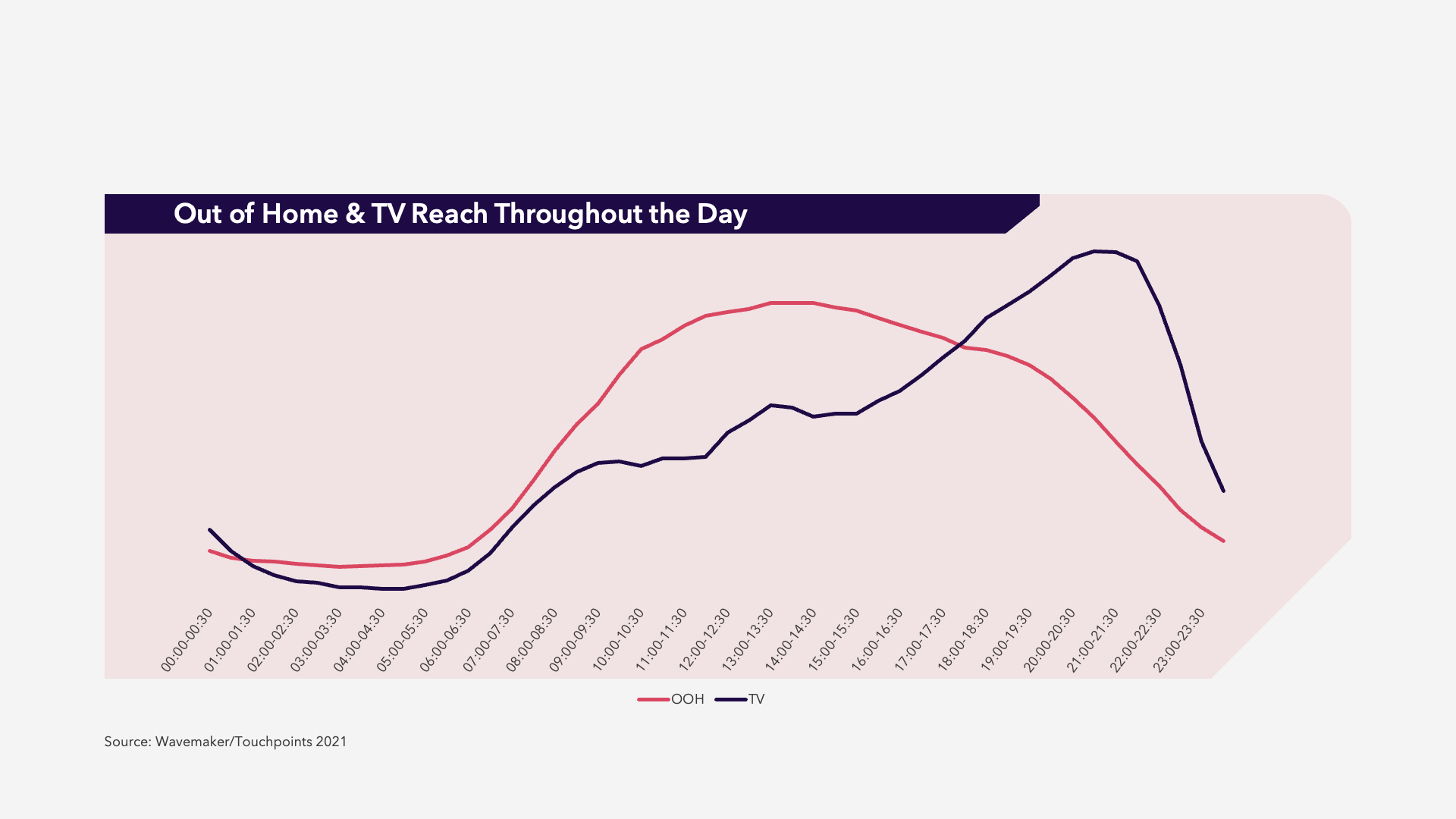
Contextually relevant messaging in OOH can increase awareness by as much as 17% and is more important than ever. By understanding mindset and mood, OOH can be used as a primer to TV or as a standalone solution. OOH’s reach is already steady throughout the day, so it’s an ideal channel to prime TV audiences before they peak at 8-10pm.
OOH’s reach is steady throughout the day, while TV’s reach gradually increases and peaks between 8-10pm
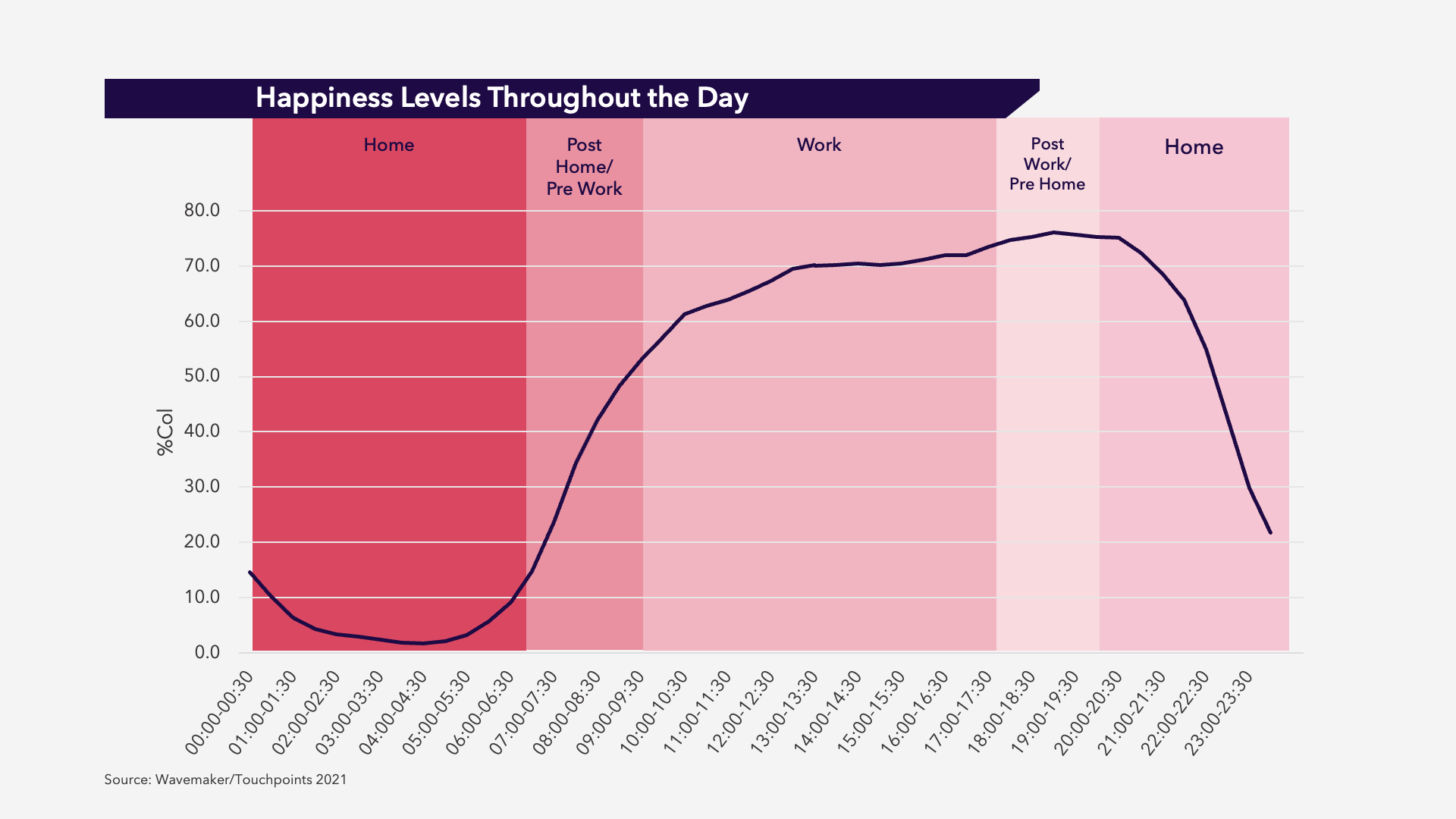
Our research shows that people’s moods improve throughout the day. And we know that advertising works harder when people are in a more positive mood. The flexibility of digital OOH allows advertisers to tap into mindsets and different emotions at specific times of the day or week via innovative, contextually relevant messaging for deeper engagement.
We also know that people are more receptive to messaging when in a relaxed frame of mind, which complements TV advertising during the evening peak when they arrive home. We would always recommend creative synergy with a cross-channel approach.
Happiness levels tend to increase throughout the day among all working adults
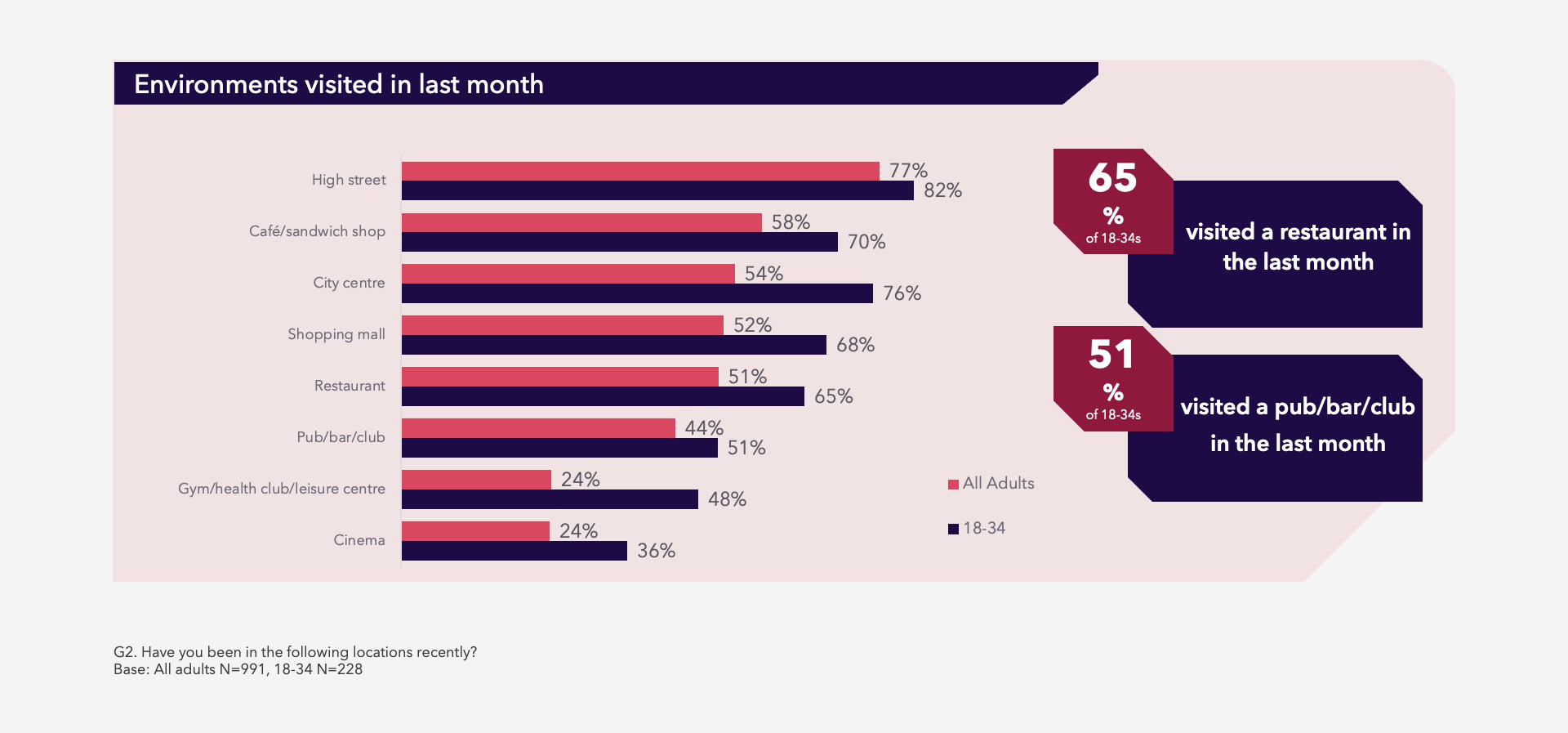
By using multiple environmental touchpoints throughout the day, OOH can deliver 9+ frequency touchpoints, particularly amongst 18-34-year-olds.
OOH provides an opportunity to reach people in a range of environments and mindsets, whether it’s the gym or the pub
In summary OOH works alongside TV in the following areas:
- As a standalone or support channel to deliver mass reach and awareness both nationally and in hyper-local geographical locations.
- As a primer, reaching consumers throughout the day and before the evening TV peak. It works as an additional touchpoint for great frequency of messaging.
- Using data, both channels complement each other to target core audiences, behaviourally and geographically.
- Both channels provide great creative context for messaging. Thanks to real-time data, we can build on this by predicting consumer attitude, mindset or mood.
- FMV digital OOH is a great platform to extend reach amongst 16–34-year-olds when planning SVOD, PVOD or BVOD.
If you’d like more information on the above, please get in touch with your regular Kinetic contact.
