
Last week we hosted our annual look at The Year Ahead.
If you missed it and want to catch up, you can view a recording of the full session here. If you just want the highlights, then keep reading.
Despite the current economic climate, the role of advertising hasn’t changed. Advertising is about creating future demand. But when finances are tight, people are more price-led and more willing to change brands, so advertising must work harder in the current climate to communicate why spending on a particular brand is worth it.
There are two clear ways to do this. Firstly, countless studies show how brands that seize the opportunity of a recession and ensure their Share of Voice (SOV) is greater than their market share grow more than brands that don’t. But this doesn’t always mean increasing marketing budgets. With many brands cutting back on spend it’s never been easier to achieve SOV greater than share of market. Know what your competition is doing and invest in reach and brand building communications to achieve greater SOV.

Secondly, if you can’t spend more than your market share, distinctiveness of assets will help brands grow this year. Distinctiveness drives memorability and advertising works harder when it stands out.
So, in 2023 people are more price sensitive and brands need to show their value more than ever. Here’s five ways brands can use OOH to grow SOV and deliver advertising that stands out.
Real-World Reach
One big way OOH will work hard for brands in 2023 is through cost-effective mass reach.
Achieving growth in the short- and long-term is not just about talking to existing customers, but by getting more people into the top of the purchase funnel. This is most effectively done by building brand awareness and consideration amongst large numbers of potential customers ready for when they’re in market.
OOH does reach better than any other media channel, reaching 97% of all UK adults every single week. In fact, OOH over-indexes for many harder to reach audiences like younger audiences and light TV viewers. OOH also over-indexes for all minority ethnic audiences. And there is a huge opportunity for brands to engage with diverse audiences. WPP’s Consumer Equality Equation report shows that if brands can get just 1% of people from minority ethnic groups to change their spending habits this equates to a £2.34bn short-term growth opportunity this year.
In 2023 achieving reach will be harder and more expensive. With ongoing inflation in TV, matched with declining audiences and fragmentation across all channels, OOH provides cost-effective, inclusive reach. Making it the obvious choice for brands looking to grow SOV and increase consideration for purchase.

Context at scale
Relevance in advertising is no longer a nice-to-have. Consumers expect messages to be tailored and relevant. And not just when they’re searching online at home.
A whopping 60% of ALL online spending is done while people are outside of the home. Brands should be tapping into this by using data to make OOH messaging and placement contextually relevant and take advantage of the fact that people are now almost always in an active mindset.
Location, environment, time, weather, events, news, sales, social – any data set can be used to trigger contextual messaging in OOH. Recent advancements in the tech to deploy dynamic and programmatic OOH means this is easier than ever to deliver at scale.
Incorporating first-party data no longer means excessive work or a live API feed at the client end. With our partners DOOH.com we can now extrapolate from first-party data in whatever form it exists and seamlessly integrate it into any digital OOH campaign. Brands can always be on, but the message and placement can be tailored to what people are searching for or where they are during a particular point of time.
So, in 2023 use the countless forms of real-time data available to inform both where your ad is seen, and what your ad is saying.

Trust Matters
Trust is fundamental to advertising effectiveness and even more so in a climate of uncertainty. Brands that are trusted achieve more customer loyalty, and customers are more likely to recommend them. They are also viewed as more valuable and therefore less impacted by a price-led market.
OOH advertising is trusted because it’s big, bold and public. It doesn’t just exist on your phone for a second, it physically exists in the real world and that makes it innately feel more trustworthy. But it isn’t just because people see a brand advertising in the real world that drives trust, it’s because everyone around them also sees the same advertising. And knowing everyone else is seeing the same message as you is a powerful driver of trust. This shared viewing experience is unique to OOH and something brands should use to counteract consumer uncertainty.
It’s no accident that OOH is used so widely for Government communications. And why, when social media companies look to build trust in their platforms, they also turn to OOH.

Creative Advantage
OOH is the Home of Creativity. And creativity is key to making advertising work harder. Analysis of thousands of Effie Awards show that exceptional creative is the second most important effectiveness driver behind market share.
Creativity is most effective when it’s distinctive, emotional, novel, well-branded and has some longevity. All qualities that can be delivered through OOH.
With OOH, brands can build creative brand experiences with commerce at the heart across every stage of the purchase funnel. QR Codes are an obvious route for enabling purchase through OOH. And have now evolved into a creative showcase with full motion video earning more attention and stimulating interaction.
Augmented Reality also offers new engaging forms of OOH creativity that elevates the creative commerce experience. The world is mapped to incredible accuracy and everything within it can be a setting or a trigger for an immersive digital experience linked to a physical location.
Last year, Kinetic and DOOH.com launched the next generation of 3D DOOH, the world’s first interactive 3D DOOH campaign. This breakthrough enables direct consumer engagement with on-screen content and opens up exciting opportunities for product personalisation, exploration and gamification of 3D content.
In 2023, more brands will explore the possibilities of 3D OOH and AR to layer entertainment, commerce and utility over OOH events, environments and media, improving people’s OOH experience, increasing interaction and standing out.

Responsible Choice
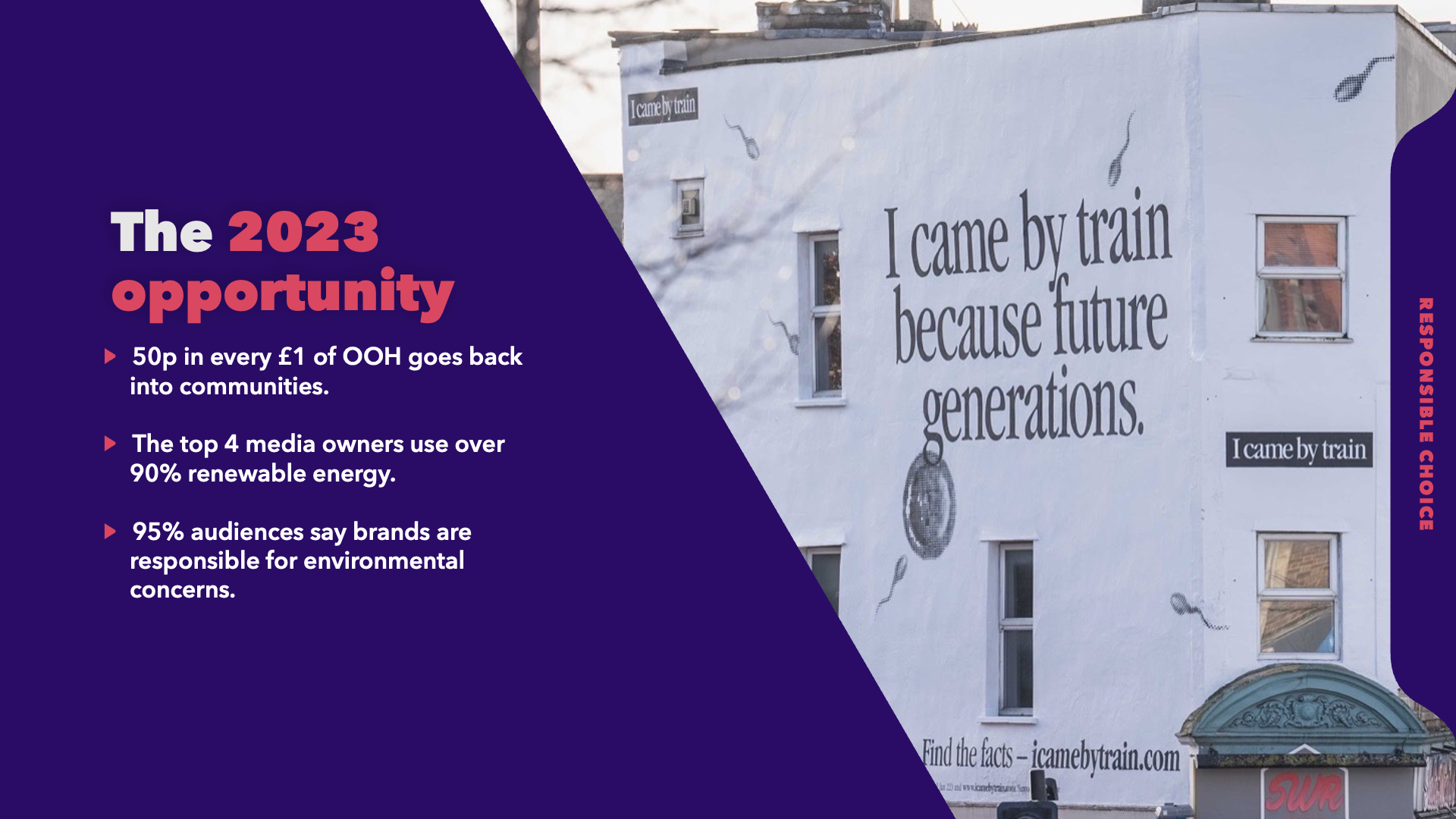
95% of people say brands are responsible for environmental concerns. And with levels of scrutiny about what advertising is funding and its environmental and social impacts rising, OOH is an easy choice to make for brands.
Serving communities and improving the quality of public life has been part of OOH’s DNA for many years. Almost 50p in every £1 of OOH revenue goes back to local authorities to help fund public infrastructure, transport networks and the wider economy.
OOH media owners are continuously investing in eco-friendly formats, and sustainable materials have now become the default for all new inventory. Living walls and bus shelters, water harvesting units, bee hotels and air purifying capabilities are now in place right across the country. Sustainable materials like Kavalan, which offers all the strength, durability and benefits of PVC, but none of the harmful environmental effects are widely available.
And over 90% of all electricity sourced and paid for by the top four OOH media owners, is from renewable sources.
OOH is often mistakenly assumed to be the least sustainable medium given its physical, and public nature but data shows that it’s actually one of the most sustainable mediums on an emissions per impressions basis.
It’s an easy and responsible choice for brands to make in 2023.
If you would like more information about any of the topics covered here, please get in contact with the Kinetic team.
