
At Mindshare’s 2023 Huddle, we hosted a fireside chat with two minority-owned businesses who shared some of the challenges they’ve encountered, and how initiatives by OOH media owners like Clear Channel and JCDecaux are helping to break down some of the obstacles faced by founders to sow the seeds for more diverse talent to grow and seize opportunities. They gave insight into how they’ve used OOH to help scale their brands and engage with a wider audience, as well as the broader positive effects that inclusive representation on public media has on under-represented ethnic minority communities.
Cheryl Crilley, Business Director at Kinetic (Chair)
Priya Chande, Global Brand Director at WUKA
Serlina Boyd, Founder and Publishing Director at Cocoa
Cheryl – What was the motivation behind WUKA and what were some of the challenges you faced?
Priya – WUKA stands for Wake Up Kick Ass, because we believe that every woman and girl around the world should be able to kick ass throughout their menstrual cycle. We were founded by an incredible woman called Ruby Raut, who was born and brought up in a remote part of Nepal, and experienced period stigma first-hand.
10 years ago, Ruby came to the UK in search of a better education and while she was studying environmental science she realised the sheer amount of waste generated by single-use pads and tampons.
So, she bought herself a second-hand sewing machine to make the first pair of WUKA period pants five years ago, and since then we’ve helped over half a million women switch to a reusable, carbon-neutral, comfortable alternative.
It’s had its challenges – we’re entirely self-funded and every bit of profit each month goes back into the business.
Cheryl – How did you look to initially raise awareness using advertising and has that changed over time?
Priya – We’re primarily a B2C business so in the early days our business invested in digital marketing and influencers. As time’s gone on, we’ve been able to add OOH into the mix as a part of a whole ecosystem of other media channels, which has certainly been a more sophisticated approach.
Cheryl – Serlina, Cocoa Girl Magazine was your first launch. How did it all start and what were some of the challenges you initially faced?
Serlina – It started with my daughter, Faith, who was being bullied at school a few months before lockdown. I started homeschooling and when we went to the supermarket to get supplies, Faith was drawn to a Frozen magazine – she was always saying she wanted Elsa’s hair, because she didn’t like her own hair.
I couldn’t see any magazines that would make her feel better about herself. So, I thought we’d work on a project together and start our own.
My husband’s a photographer, it was lockdown, so I put Faith on the front cover of our little magazine. I asked for some advice from a publisher I used to work with and said, “what do you think about this magazine?” and he said, “Absolutely not – it won’t sell. No one’s going to advertise in it.” And I thought, ‘whatever, I’m gonna do it anyway’.
Cheryl – What role did advertising play for Cocoa Girl in the beginning?

Serlina – Advertising was incredible. We did a partnership with Clear Channel, which was a brilliant way to get our magazine out there. Being on OOH drew so many brands to us, and so many people to the website, to find out what Cocoa was about.
We won a big brand deal with LOL Dolls, and worked on some huge campaigns with them as a result of being on billboards where children could see themselves. We had little girls crying because they’d never seen anything like it before.
Cheryl – WUKA has been running a brilliant OOH campaign centred around Desi Period Stories. How much importance did OOH’s public nature have on your creative and media placement, given periods are still considered a taboo topic for many? And what has the reaction from people been like?
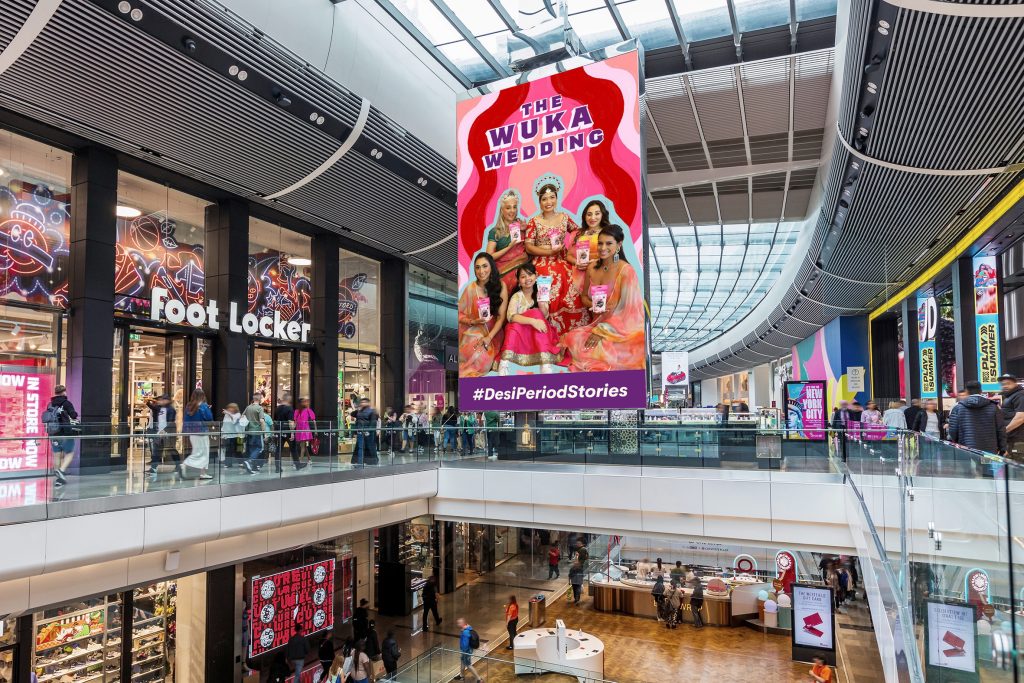
Priya – It’s played a massive role. We were fortunate to have the Reach Programme with JCDecaux who’ve been guiding us. I don’t think, without them and the very targeted nature of this campaign, we’d have ever run a campaign like this.
We’ve had a lot of journalists off the back of this reach out and say, “you’re alienating people by using words that are in Hindi, you’re in the UK”. And we had to stand firm and explain that the exact point of this campaign is to speak to people who would otherwise not be spoken to, but who, as a group, are growing in size, who have spending power, have a voice and something to say about this topic.
So, we were very tactically placed in Westfield malls in London – Stratford and White City. Everyone that’s seen it has said they’ve never seen anything like this before.
Cheryl – I thought it was incredible, being a South Asian myself, it was incredible to see. And the creative was spot on as well.
What has some of the reaction been from people since you’ve run this campaign?
Priya – Well, I think it’s probably worth letting the public do the talking:
Priya – The BBC and other news titles have picked it up, we’ve been on TV and radio, but more than that, it’s the community response. We’ve had well over a thousand people reach out and say, “this is what happened to me. Thanks goodness you’re talking about this, because as a child, no one talked to me about periods and I’ve always been ashamed of it”. And that’s a big part of what we do. We don’t just sell a product, we’re a brand that is here to make an impact, which is about smashing stigmas and breaking taboos. So, this has had a dual effect.
Cheryl – What advice would you give to other minority-ethnic startups when making media choices or looking to take the next step?
Priya – We have never shied away from fishing for opportunities, but we’ve also been very fortunate to have people reach out to us. And funnily enough, that’s what happened with the Reach Programme. It was a contact at JCDecaux that I was connected with that said, “I’ve just read your story about Ruby and the Sari rags and I’ve got a feeling the Reach Programme is going to be a really good fit for you, you should apply”.
There are amazing opportunities out there for startups. Incredible larger organisations are creating the space, setting aside budget and allocating teams dedicated to helping either minority-ethnic founders or sustainable businesses. Seek them out. Contact those people. And if you’re not sure whether your brand qualifies, do it anyway.
Cheryl – Serlina, is there anything you think other brands and people working in media should be doing to make advertising work better for themselves but also for ethnic-minority brands and communities?
Serlina – I’ve managed to reach an untapped audience that basically had their head down for a long time and felt that certain things weren’t for them. So, it would be great to work with businesses, be around the table to give ideas, to make sure that when you’re doing these campaigns, you’re reaching this audience authentically.
OOH has been instrumental in helping my business grow. I think there should be more investment, especially in black-owned brands who don’t always have the finances. When these businesses use OOH and other advertising, they get brands coming to them because they’ve been seen, and then later down the line, they’ll have the money to re-invest.
Whatever you’re putting out there shapes the character of your community. And if children are seeing amazing ads that they can relate to it will affect them positively.
Huge thanks to both our guests, we can’t wait to see what they do with OOH next.
It might surprise you to know the real, direct impact brands using OOH have on local communities. As well as being the most inclusive channel with 97% reach, regardless of age, gender, sexual orientation or ethnicity, almost 50% of OOH’s revenue is reinvested back into valuable public infrastructure.
OOH is a highly visible and public channel. Its public nature lends it the unique power of cultural imprinting – viewing something as a collective. OOH enables brands to normalise, educate and celebrate differences, together.
